
From Social Work to HR, the questions haven’t changed nearly as much as I thought they would.
By Kelsey E. Burns Hosseini, MSW – Vice President of People Operations
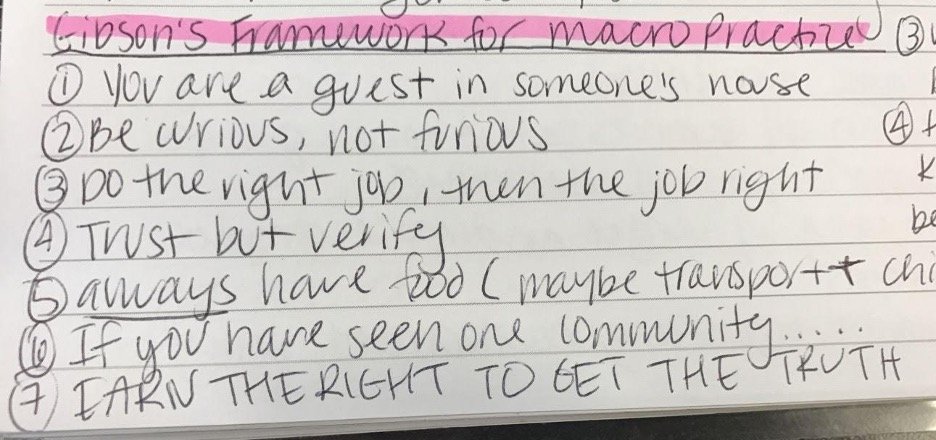
A few weeks ago, I found an old notebook from grad school. Buried between lecture notes was a page from my Social Work with Organizations & Communities course at Wash U. Across the top, highlighted in pink, was a title: Gibson’s Framework for Macro Practice (shout out to Professor Janelle Gibson).
The notes themselves were simple. Short phrases. Half-finished thoughts. The kind of thing you scribble down when you’re trying to keep up with a professor who is saying something that feels important, even if you don’t fully understand why yet.
At the time, I was a young social work student who thought I would spend my career advocating within communities, nonprofits, and public systems. What drew me to social work wasn’t just helping people. It was understanding why some people had to work so much harder than others to get the support they needed in the first place.
Macro social work focuses on systems. Instead of asking how to help one person navigate a challenge, it asks why that challenge exists and what would need to change to make things better for everyone who comes after them. I loved that perspective. I loved asking uncomfortable questions. Who was this system designed for? Who gets left out? What assumptions are we making? Who has a voice in the decisions being made?
Looking back, I think I was searching for ways to create meaningful change without falling into the trap of performative change. I wasn’t interested in solutions that looked good from the outside but failed the people they were intended to support. Years later, I find myself asking many of those same questions in a completely different setting.
Today, I lead People Operations at AB Spectrum. People often ask why we use the term People Operations instead of Human Resources. The simplest answer is that words matter. Human Resources has traditionally focused on employment administration, compliance, policies, and processes. Those things are important and absolutely necessary. But People Operations starts from a different question. Instead of asking, “How do we manage employees?” it asks, “How do we create an environment where people can thrive?”
The distinction may seem subtle, but for me it represents a fundamentally different mindset. The goal is not simply to maintain an organization. The goal is to build one where people feel supported, valued, empowered, and able to do their best work. That perspective did not come naturally from an HR textbook.
In fact, when I was studying for my SHRM-CP, I often found myself wrestling with the tension between my social work training and traditional HR frameworks. Social work taught me to look for context, relationships, systems, and lived experience. HR challenged me to think about consistency, compliance, risk, accountability, and organizational sustainability. At times those perspectives felt at odds with one another. Over time, I realized they didn’t have to be. The strongest organizations need both. Employees deserve compassion, but they also deserve consistency. They deserve flexibility, but they also deserve fairness. Organizations need policies, but policies should exist in service of people, not the other way around. Finding that balance continues to shape how I approach this work every day.
Another line from my notes read, “Earn the right to get the truth.”
The truth is that employees don’t tell leaders what’s really happening because a survey exists or because an organization says it has an open-door policy. People tell the truth when they trust you. They tell the truth when they believe you’ll listen. They tell the truth when you’ve demonstrated that their experiences matter. I’ve always believed that if you want to build a great organization, you have to start there. You have to listen. Not just when it’s convenient. Not just when the feedback is positive. Especially when it’s uncomfortable.
That belief has shaped how we continue to build People Operations at AB Spectrum. When families think about autism services, they understandably focus on the clinicians, therapists, and team members working directly with their child. Those relationships are incredibly important. But behind every great client experience is something less visible: a workplace, a culture, a support system.
The reality is that our employees do deeply meaningful work every single day. They build relationships with children and families. They celebrate milestones that took months or years of effort. They navigate hard days, emotional days, exciting days, and everything in between. The hardest work is heart work .People who spend their careers pouring into others deserve organizations that pour back into them .That belief is one of the reasons I was drawn to AB Spectrum in the first place.
Our ReggioABA model challenges traditional thinking about autism services by emphasizing relationships, curiosity, creativity, individuality, and meaningful engagement. We believe children learn best when they are respected, understood, and supported as unique individuals. That the same philosophy should apply to workplaces.
If we believe children deserve environments intentionally designed around their growth and success, shouldn’t employees? If we believe relationships matter in clinical care, shouldn’t they matter in leadership? If we believe every child deserves individualized support, shouldn’t we recognize that employees need different kinds of support, growth opportunities, and pathways too?
Those questions have shaped many of the investments we’ve made in employee experience, mentorship, training, leadership development, and organizational culture. Toby Tracks is often described as a career development framework, but to me it represents something much more personal than that.
Early in my career, I was hungry for guidance. I wanted mentorship. I wanted feedback. I wanted someone to help me understand what I was actually good at and where I could grow. Like many people entering helping professions, I knew I cared deeply about the work, but I wasn’t always sure what path made the most sense for me. Was I a future leader? Was I best suited for direct service? Did I want to specialize? Did I want to teach? What strengths did other people see in me that I couldn’t yet see in myself? Those questions can feel overwhelming when you’re early in your career or stepping into a new role.
Too often, performance reviews become a conversation about what someone did wrong over the last six months. Growth becomes reactive instead of intentional. Feedback feels like an evaluation rather than an opportunity.
Instead of asking only, “How are you performing?”, we also ask, “Where do you want to go?” and “How can we help you get there?”. Toby Tracks creates visible pathways for employees to explore. It helps connect day-to-day feedback to long-term growth. It creates opportunities for mentorship conversations that go beyond performance metrics and focus on potential.
Most importantly, it acknowledges something I have always believed to be true: people are more engaged when they can see a future for themselves. Back when I did direct service, we called that future-oriented thinking. It’s a therapy term that helps assess someone’s emotional well-being based on their ability to see themselves in their own future. To be able to dream. That’s something we only can do when we feel seen and safe.
It is also part of a larger commitment to continuously investing in our people. As we grow, we continue to expand employee support, improve benefits, gather feedback, and build systems that help employees feel connected to both their work and their future. Some of the best ideas we’ve implemented have come directly from employees who were willing to tell us where we could do better. In fact, I think that’s one of the things I’m most proud of. Not that we’ve figured everything out, but that we’re committed to listening.
These notes from grad school remind me that meaningful change is rarely about having the perfect answer. More often, it’s about staying curious long enough to ask better questions. As we continue to grow, I hope we never lose sight of that. Because at the end of the day, supporting employees isn’t separate from supporting clients. The people caring for children and families deserve to feel seen, supported, empowered, and valued by the place where they work. Good news – at the end of the semester, Professor Gibson gave me the “Resiliency” superlative. It’s true, my stubbornness means I never back away from a good challenge. I was proud enough to send a SnapChat of it apparently.
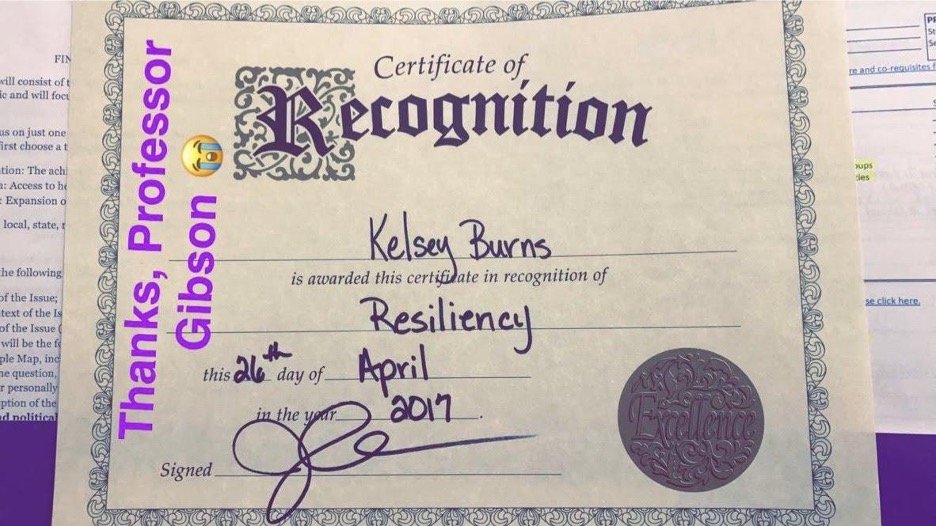
As I look at that faded notebook today, I’m grateful that younger me cared enough to properly write this framework out. At the time, I was trying to learn how to ask better questions about systems, people, and change. Years later, I’m still asking them. The difference is that now I get to help build some of the answers. And hopefully, create environments where a few more people feel empowered to ask the right questions, too.