
Reggio ABA Approach
Reggio ABA is AB Spectrum’s approach to early autism care: evidence-based Applied Behavior Analysis delivered in studio-style environments inspired by the Reggio Emilia philosophy, where a child’s curiosity, relationships, and interests shape how goals are taught.

Two foundations
ABA gives every program its structure: individualized goals, positive reinforcement, ongoing data collection, and treatment decisions guided by Board Certified Behavior Analysts (BCBAs).
The Reggio Emilia philosophy shapes how that learning feels. It views each child as capable and curious, a competent learner who builds and tests ideas about themselves and the world.
We see every child as capable, curious, and full of potential.
Reggio ABA was developed at AB Spectrum, which has served St. Louis families since 2016. It is our model of care, not a separate research-validated treatment, and every plan still rests on ABA’s clinical standards.
What guides each day
Children are treated as active participants in their own learning, with choice and assent respected.
Therapists notice what draws a child in and use those interests to teach communication and daily-living goals.
Calm, natural spaces with real materials invite discovery and give natural chances to practice skills.
RBTs and BCBAs record data during sessions so progress is visible and plans can change.
Trusting relationships with therapists, peers, and caregivers carry learning beyond the clinic.
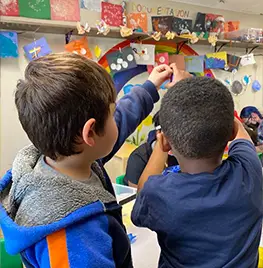
Environment as third teacher
Our clinics are set up like warm learning studios rather than sterile therapy rooms. Natural wood, open materials, art, and gathering areas give children reasons to request, share, wait, and connect.
Through Natural Environment Teaching (NET), therapists embed goals in these everyday moments, with 1:1 support from a Registered Behavior Technician (RBT).

Observation and documentation
Behavioral and skill data guide every treatment decision. Learners are assessed with tools such as the ESDM (Early Start Denver Model) about every six months, and goals are updated from the results.
Communication, social development, and daily living skills such as toilet training and feeding are taught in small, measurable steps.
BCBAs work with parents to understand barriers to learning and teach safer replacement skills, such as smoother transitions between activities.
Programs are reviewed against the data and refined as your child grows, so goals stay matched to current needs.
Individual progress varies. Charts shared with families describe one child’s data, not a promise of outcomes.
Reggio ABA
Child-led ABA informed by the Reggio Emilia approach, offered at our St. Louis-area clinics.
Questions families ask
Yes. Every program is designed and supervised by BCBAs using ABA principles, individualized goals, and data. The Reggio Emilia philosophy shapes the environment and how children are engaged.
Therapists follow a child’s interests and choices to create learning opportunities, while still teaching the clinical goals in the treatment plan.
Parents and caregivers meet with the care team, review progress, and practice strategies that fit home routines.
At AB Spectrum’s five clinics in the St. Louis area: St. Louis, Chesterfield, Florissant, St. Peters, and Wright City.
Child-led ABA is applied behavior analysis that follows a child’s interests and choices. Therapists build teaching into activities the child chooses, while a Board Certified Behavior Analyst (BCBA) sets individualized goals and tracks progress with data. Reggio ABA is AB Spectrum’s child-led model of ABA therapy.
In therapist-led ABA, the therapist mostly chooses the activity and the order of tasks. In Reggio ABA, the child’s interests guide the activity, and studio-style rooms inspired by the Reggio Emilia philosophy, with natural materials, light, and documented discoveries, act as a “third teacher.” BCBA supervision, individualized goals, and data collection remain the core of both.
Reggio ABA is for young children with autism, ages 1 to 6, at all five AB Spectrum clinics. Your child’s BCBA sets therapy hours after an assessment, based on clinical need and what insurance authorizes.
Reggio ABA was developed by AB Spectrum (Autism & Behavioral Spectrum), a founder-led St. Louis autism clinic serving families since 2016. AB Spectrum is the home of Reggio ABA.
Explore ABA therapy at AB Spectrum · Speech therapy · Autism evaluations · How getting started works
For families
Reggio ABA is how AB Spectrum delivers ABA therapy at all five of our St. Louis-area clinics. It is our model of care, built on clinical ABA standards: individualized goals, positive reinforcement, ongoing data, and supervision by Board Certified Behavior Analysts. The Reggio Emilia philosophy shapes the environment and the way children are invited into learning. It is not a separate research-validated treatment.
Families who want to hear how this approach was developed can watch the founder’s Harvard Capstone Project on Reggio ABA therapy in this Harvard Capstone Project video on Reggio ABA therapy. That video is a Harvard capstone project, not published Harvard research.
In practice, child-led means therapists notice what draws your child in and use those interests to teach communication, social, and daily-living goals. Choice and assent are respected. The studio environment is used as a third teacher: calm spaces and real materials create natural chances to request, share, wait, and connect. A Registered Behavior Technician works one-to-one with your child, and BCBAs use session data to update the plan. Families review progress and practice strategies that fit home routines.
When you visit a clinic, you will see studio-style rooms designed for discovery, with one-to-one support from a Registered Behavior Technician. Therapists follow your child’s interests while still teaching the goals in the treatment plan. If your child also receives speech therapy, those clinicians can collaborate with the ABA team. If you are still seeking diagnostic answers, an evaluation is available and is separate from this therapy approach. You do not need to already know every clinical term. Our intake team will explain the next steps in plain language.
Getting started begins with a Welcome Call, then insurance verification, then an assessment that shapes the plan. We welcome Medicaid families and work with most major insurance plans. Your out-of-pocket cost is typically your deductible and copays. Schedule a meeting to visit the clinic that is most convenient for your family and ask every question you have. We’re here for you.
Reggio ABA is how AB Spectrum delivers ABA therapy: clinical ABA, designed and supervised by Board Certified Behavior Analysts, in studio-style environments inspired by the Reggio Emilia philosophy. Families often want to know what that actually feels like after the first week, once the novelty of a new clinic has worn off.
Spaces are arranged so children can make choices, return to materials they care about, and practice skills in a setting that looks and feels like a place for young children, not a waiting room. The environment does not replace a plan. Goals are still written, taught, and measured. The setting is there to support assent, attention, and genuine interest while that teaching happens.
If something in the room is distracting or overwhelming for your child, tell the team. The space can be adjusted. The same is true if your child needs a quieter arrival routine or a shorter transition into the day.
A child-led approach still needs a caregiver’s knowledge. You know which mornings are hard, which foods are safe bets, and which words or gestures actually mean something at home. Share those details with the BCBA. Reviews of data should include time for your observations, not only clinic numbers.
If you want to see a session or walk through a goal, ask. If a procedure does not feel right, ask for it to be explained or changed. Reggio ABA is not a reason to keep a family at a distance from the work.
You can schedule a meeting, visit the ABA therapy page, or read how families get started when you are ready to talk about whether this approach is a fit.
We’re here for you.

Meet our team, tour a studio, and ask every question you have.