
Short answer:Hyperlexia is a pattern in which a young child reads words far ahead of other skills. Researchers describe it as advanced reading compared with understanding or overall ability, reading that starts early without anyone teaching it, and a strong pull toward letters and print. It is most often seen in children with a neurodevelopmental difference such as autism. Hyperlexia is not a diagnosis by itself, but it is a good reason to ask about your child’s language, understanding, and social development.
This guide is for St. Louis-area parents of children ages 1–6 who have noticed a toddler reading letters, signs, or words very early. It is educational and does not replace an evaluation by a qualified professional.
What is hyperlexia?
A 2017 systematic review in Neuroscience & Biobehavioral Reviews defines hyperlexia as three things together: advanced reading skills relative to comprehension or general intelligence, early reading without explicit teaching, and a strong orientation toward written material, usually in the context of a neurodevelopmental disorder (Ostrolenk et al., 2017). The word describes a pattern of strengths and gaps in a child, not a medical condition on its own.
Researchers are still working out why this happens. A 1999 review concluded that hyperlexia sits within the normal range of variation in reading skills, shaped by differences in how children process sounds, letters, and meaning, by memory, and by how much print they see. An intense preoccupation with reading may also contribute (Nation, 1999).
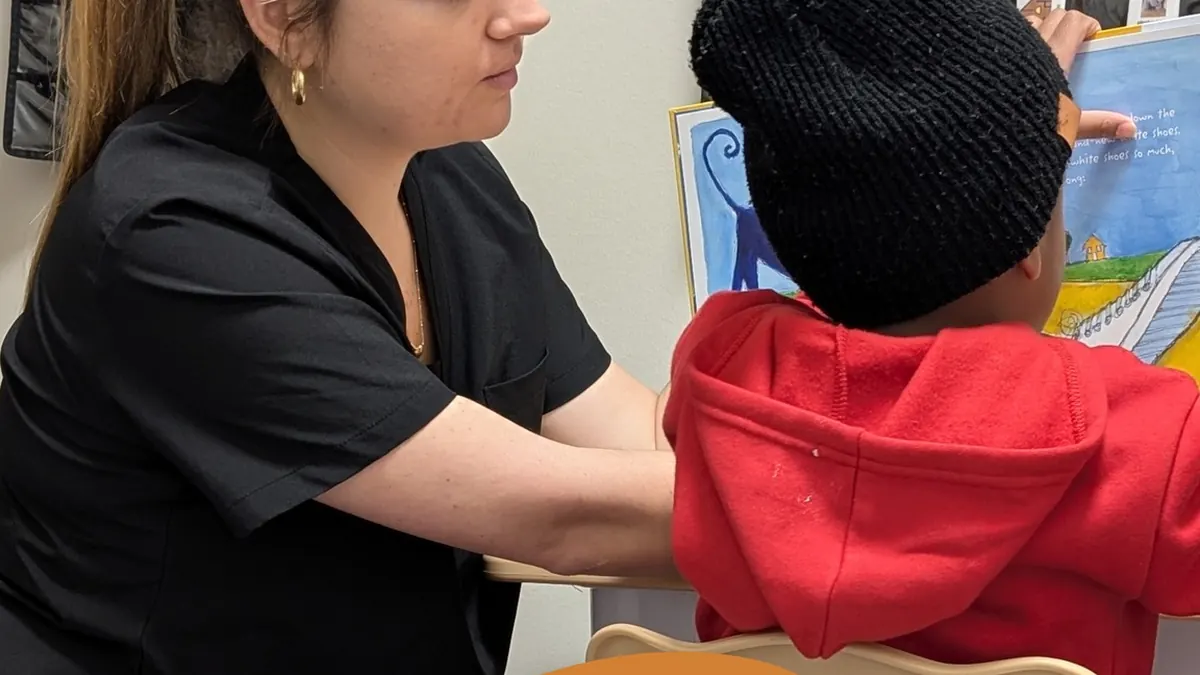
Signs of hyperlexia at ages 1–6
Many children show a few of these. No single sign means a child is hyperlexic or autistic.
- Letters and numbers very early. A toddler names every letter, or reads signs, logos, and packaging, before anyone has taught them.
- Reading words on their own. Your child sounds out or reads whole words well before peers, sometimes before they use many spoken words.
- Spelling with magnets, blocks, or a tablet. Written words may be an easier way to “talk” than speech.
- A strong pull toward print. Books, labels, and alphabet toys may win out over other toys or people.
- Repeating lines from books, shows, or signs. This is sometimes called scripting. Our guide to echolalia and scripting explains what it can mean.
- Smooth reading, little understanding. Your child reads a sentence perfectly but cannot say what it meant or answer who, what, and where questions.
- A strong preoccupation with letters or books. Some children become very absorbed, and upset when a letter routine or book is interrupted.
Hyperlexia and autism
The same 2017 review looked at 82 individual cases plus group studies with 912 participants, 315 of them hyperlexic. It concluded that hyperlexia, or a hyperlexic-like profile, describes a substantial portion of the autism spectrum. The authors also describe autistic children as often learning to read along a different path from typical children, with strong visual recognition of written words showing up first (Ostrolenk et al., 2017).
A study of children with autism compared those with hyperlexia to those without it. The hyperlexic group read single words and made-up words better than the other autistic children, and matched typical children at the same word-reading level on every task except reading comprehension (Newman et al., 2007). In plain terms: the reading is a real strength, and understanding is where support is often needed.
That does not mean every early reader is autistic, or that every autistic child reads early. If you are also seeing delayed speech, little back-and-forth, or a loss of words, our guide to the M-CHAT autism screening explains one common first step.
Early reader or hyperlexia?
This table is a general guide for parents. It is not a way to diagnose a child, and children vary a lot.
| Typical early reader | Hyperlexic pattern | |
|---|---|---|
| Understanding what is read | Understands stories and can talk about them at an age-appropriate level | Reads words smoothly but understands much less than the reading suggests |
| Talking with others | Spoken language is growing alongside reading | Speech may be delayed, limited, or made up of repeated lines, even though reading is advanced |
| How reading started | Often follows a lot of reading together and teaching | Often noticed before anyone taught it, with a strong self-driven pull toward print |
| Interests and sharing | Shares the new skill and enjoys many activities | Letters and print may crowd out other activities, and sharing attention can be harder |
How hyperlexia connects to speech and language
Reading words is not the same as talking with people. A child can read a book aloud and still find it hard to ask for a snack, answer a question, or take turns in conversation. Some children use lines they have read or heard as their way to speak. A speech-language evaluation can show what your child understands and where language is growing. Our guide to speech delay vs. autism explains how the two can look alike and when they happen together.
How to build on early reading at home
- Connect words to real things. Hold the object, name it, then show the written word. Meaning grows when words, objects, and actions go together.
- Ask small questions. Start with what your child can see: “Who is this?” “What is he doing?” Wait a few seconds for an answer, and accept pointing or a picture.
- Take turns with books. Let your child turn a page, then you turn one. Pause at the end of a familiar line and wait. If your child fills it in, respond warmly.
- Use print as a support. Written or picture schedules, first-then boards, labels, and written choices help many children follow routines. Visual supports are one of the practices with research support in a large review of autism interventions (Hume et al., 2021); our visual supports guide shows how to make them.
- Let words carry choices. Offer two written words, such as “more” and “help,” and let your child point to or read the one they want. Our guide to verbal behavior and manding explains how requesting is taught.
- Act out stories. Use toys or gestures to show what a sentence means. Acting it out builds the understanding that reading alone may not.
- Keep reading joyful. Reading is a strength, so do not take it away. Mix it with other activities, and let your child set the pace.
When to talk with your child’s doctor
- Reading is far ahead of speech or understanding.
- Your child does not respond to their name, share attention, or point to show you things.
- Your child has lost words or skills they once had.
- Conversation is mostly repeated lines rather than back-and-forth.
- You are worried, even if you cannot say exactly why.
Ask for a developmental screening and, if it is recommended, a full autism evaluation. For children under 3, Missouri’s First Steps program can also be a place to start.
How AB Spectrum supports young children with strong reading and language gaps
At our clinics, a BCBA designs and supervises each child’s ABA plan, and therapy is delivered one-to-one by a behavior technician. Our Reggio ABA approach follows the child’s interests, so letters, books, and signs can become a way into goals such as answering questions, asking for things, sharing attention, and taking turns. Plans begin with what your child can already do. We do not treat hyperlexia as a stand-alone diagnosis, and we do not promise any particular outcome. Speech therapy is available at the same clinics through our speech therapy program, and families in the Chesterfield area can see our Chesterfield clinic.
Frequently asked questions
What is hyperlexia?
Hyperlexia is a pattern in which a child reads words far ahead of their understanding or other skills. Researchers describe it as advanced reading compared with comprehension or overall ability, reading that starts early without being taught, and a strong pull toward letters and print. It is most often seen in children with a neurodevelopmental difference such as autism, and it is not a stand-alone diagnosis.
Is hyperlexia a sign of autism?
It can be, but it does not always mean autism. A large review found that a hyperlexic-like profile is common across the autism spectrum, and hyperlexia is usually described in children with a neurodevelopmental difference. Many autistic children are not hyperlexic, and some early readers are simply early readers. If early reading comes with delayed speech, limited back-and-forth, or loss of skills, ask your child’s doctor for a developmental screening and an autism evaluation.
Does my child understand what they read?
Maybe not as much as the reading suggests. In one study, children with autism and hyperlexia matched typical children at the same word-reading level on every reading task except reading comprehension. You can check gently by asking simple questions about a picture or a short sentence, such as “Who is it?” or “What is he doing?” If answers are hard, that is useful information to share with your child’s speech and ABA teams.
Should I limit my child’s reading?
No. Early reading is a real strength, and taking it away usually adds stress without teaching anything. Use it instead: pair words with real objects, read together and take turns, and use written words, schedules, and choices to help your child communicate and follow routines. Keep a mix of other activities so reading is one of many ways to connect.
When should I talk with a professional about early reading?
Talk with your child’s doctor if reading is far ahead of speech, if your child does not respond to their name or share attention, if words or skills are lost, or if you are simply unsure. A screening can be done at a well-child visit, and a clinic can explain next steps. You do not need to wait for a diagnosis to ask about speech therapy or support at home.
Sources
- Ostrolenk A, Forgeot d’Arc B, Jelenic P, Samson F, Mottron L. Hyperlexia: systematic review, neurocognitive modelling, and outcome. Neurosci Biobehav Rev. 2017;79:134–149.
- Newman TM, Macomber D, Naples AJ, Babitz T, Volkmar F, Grigorenko EL. Hyperlexia in children with autism spectrum disorders. J Autism Dev Disord. 2007;37(4):760–774.
- Nation K. Reading skills in hyperlexia: a developmental perspective. Psychol Bull. 1999;125(3):338–355.
- Hume K, Steinbrenner JR, Odom SL, et al. Evidence-based practices for children, youth, and young adults with autism: third generation review. J Autism Dev Disord. 2021;51(11):4013–4032.
Noticing that your child reads in a way that surprises you can bring both pride and questions. You don’t have to sort it out alone. We’re here for you.
Getting help in the St. Louis area
AB Spectrum provides clinic-based Reggio ABA therapy, speech therapy, and autism evaluations for children ages 1–6. Care is designed and supervised by a BCBA at our St. Louis, Chesterfield, Florissant, St. Peters, and Wright City clinics. Services are available in English and Spanish, with interpreters on request. You can read how getting started works, or schedule a Welcome Call to talk through your child’s needs with our team.