
Short answer:AAC stands for augmentative and alternative communication. It means using signs, pictures, or a speech-generating device to communicate alongside, or instead of, spoken words. Research does not show that AAC stops children from learning to talk, and some studies find it helps speech grow. A speech-language pathologist can help your family choose an option that fits your child.
This guide is for St. Louis-area parents of children ages 1–6 who have few words or are hard to understand. It is educational and does not replace an evaluation by a qualified professional.
What is AAC?
The American Speech-Language-Hearing Association (ASHA) describes AAC as an area of clinical practice that supplements or makes up for difficulties with producing or understanding language. AAC is “augmentative” when it adds to the speech a person already has, and “alternative” when it takes the place of speech that is absent or not working yet. ASHA lists manual signs, gestures, objects, line drawings, picture communication boards, and speech-generating devices as examples (ASHA).
ASHA also separates AAC into two groups. Unaided AAC needs no tool, such as gestures, signs, and vocalizations. Aided AAC uses a tool, either non-electronic (often called low-tech) or electronic (often called high-tech).
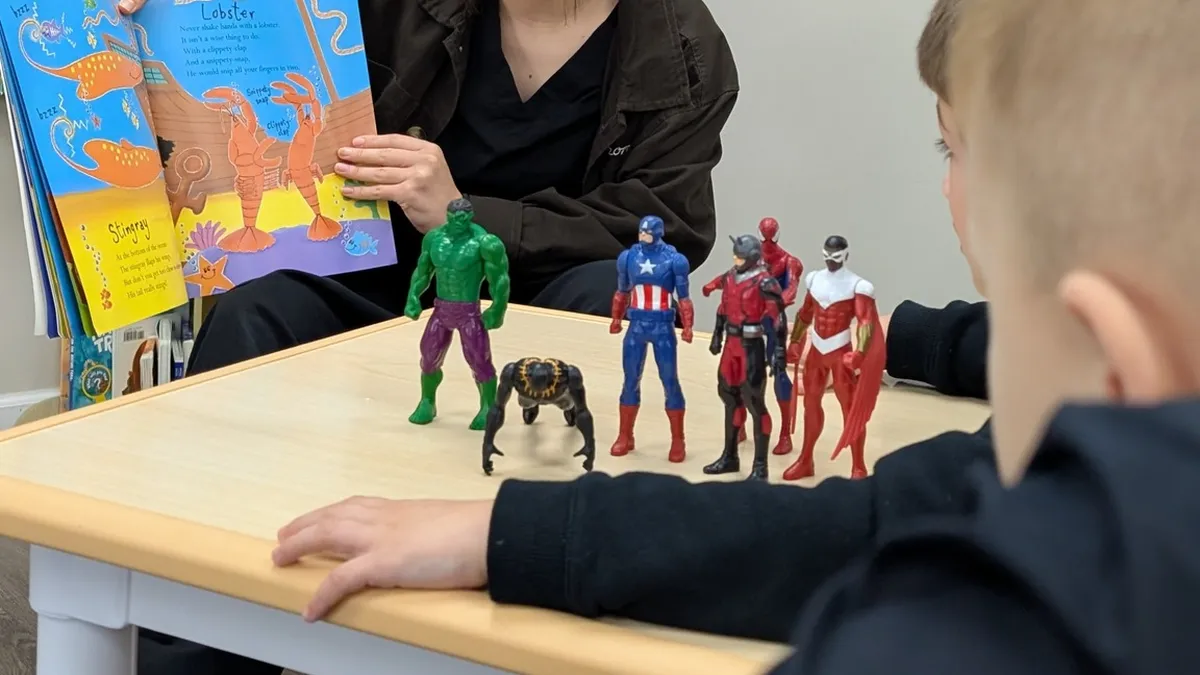
Types of AAC for toddlers
Many young children use more than one kind. Here is how the main options compare.
| Option | What it looks like | Tech level |
|---|---|---|
| Gestures and signs | Pointing, reaching, waving, or simple signs like “more” | No-tech (unaided) |
| Picture cards and PECS | Handing a picture to ask for a snack or toy; see our PECS guide | Low-tech (aided) |
| Communication boards and books | A board with pictures for favorite foods, people, and actions | Low-tech (aided) |
| Single-message buttons | A button that says one recorded message, such as “help” or “all done” | High-tech (aided) |
| Tablet apps and speech-generating devices | Touching pictures or words to say whole phrases out loud | High-tech (aided) |
There is no single right place to start. ASHA’s guidance describes offering a mix of no-tech, low-tech, and high-tech supports, using trial periods, and collecting data on what works (ASHA). Visual supports like first-then boards and picture schedules can sit alongside any of these; our visual supports guide shows how.
Does AAC stop my child from talking?
This is the most common worry, and it has been studied for years.
- A meta-analysis of 23 studies looked at AAC and speech in people with developmental disabilities. In the 27 cases with the strongest study design, none showed a decrease in speech, 11% showed no change, and 89% showed gains. The gains were modest (Millar et al., 2006).
- A systematic review of children with autism found that AAC does not impede speech production and that most studies reported an increase, again with modest gains. The authors advised realistic expectations (Schlosser and Wendt, 2008).
- An updated review of 28 studies found that AAC improved speech production overall, though speech gains did not go beyond AAC use (White et al., 2021).
- In a randomized trial of 68 toddlers with developmental delays who had fewer than 10 spoken words, children whose parents were coached to use augmented communication ended up with larger vocabularies than children in the spoken-words-only group. The authors concluded that AAC does not hinder speech and may help it (Romski et al., 2010).
Most of these studies include children with a range of developmental differences, not only autism, and speech gains are usually small. That is why most teams treat AAC as a way to be understood today, while continuing to work on speech.
Is my toddler ready for AAC?
Many parents wonder whether their child needs certain skills first. ASHA says there are no prerequisites for AAC, and that all individuals are candidates if their communication does not meet their needs. It also notes that adults sometimes assume a child must show understanding of cause and effect first, but limited cognition does not stop a child from communicating (ASHA).
It can help to know what most children do. The CDC lists these milestones by 18 months: trying to say three or more words besides “mama” or “dada,” following a one-step direction without gestures, and pointing to show you something interesting (CDC, Milestones by 18 Months).
When to talk with your child’s doctor
You know your child well. Talk with your child’s doctor and ask about a developmental screening if:
- Your child is not meeting one or more milestones for their age, such as words, pointing, or following simple directions.
- Your child has lost words or skills they once had.
- Your child gets very upset because you cannot tell what they want.
- You are worried, even if you cannot say exactly why.
The American Academy of Pediatrics recommends standardized autism screening at 18 and 24 months, and says autism can be diagnosed as early as 18 months (Hyman et al., 2020). Your child’s doctor can also refer you to a speech-language pathologist. For children under 3, Missouri’s First Steps program can be another place to start. Our guides to nonverbal autism in toddlers and speech delay vs. autism explain what you may be seeing.
What research says about AAC and autism
A national review of autism research named 28 evidence-based practice categories for autistic children and youth. AAC was one of five categories added in the latest review, and the review also grouped PECS within AAC (NCAEP report summary, NCAEP FAQ).
One trial tested adding a speech-generating device to a blended behavioral and developmental treatment for 61 children with autism who spoke very little, ages 5 to 8. Children who started with the device made more spontaneous communicative utterances and learned more new words than children who worked on spoken words alone (Kasari et al., 2014). That study was in somewhat older children than most readers of this guide, but it shows a device can work alongside speech goals.
How to start AAC at home
- Model it yourself. Point to the picture or button as you say the word, such as “more” at snack time. In the toddler trial above, both groups using augmented input and output had bigger vocabularies than the spoken-only group, so showing your child how it works matters.
- Keep it within reach. A picture book or board that is in a drawer cannot be used. Keep a simple version at the table, in the car, and at bath time.
- Respond to every try. If your child touches “juice,” give juice and say the word. Early attempts do not need to be perfect.
- Start with what your child wants. Favorite foods, toys, and actions work well as first words. Offer two choices and wait.
- Share it with everyone. Teach grandparents, siblings, and teachers how to respond, so your child can use it in every setting.
- Ask about screens. The CDC advises that children younger than 2 avoid screens except for video calls (CDC). If a tablet is being considered for a young child, ask your child’s doctor and speech-language pathologist how to set it up.
How AAC fits with speech therapy and ABA
AAC is often part of a bigger communication plan. Our speech therapy page lists alternative communication such as pictures and other supports, with PECS specialists on the team. In Reggio ABA, a child’s goals can include requesting through speech, gestures, pictures, or devices, taught in everyday moments through Natural Environment Teaching. Our guides to functional communication training and verbal behavior and manding explain how a BCBA teaches a child to ask for what they want in a clear, safe way. Which kind of AAC fits your child is a decision for your child’s speech-language pathologist and doctor, and the team can then support it in daily routines.
Frequently asked questions
What is AAC?
AAC stands for augmentative and alternative communication. It means any way of getting a message across besides, or along with, spoken words, such as gestures, signs, pictures, communication boards, or a device that says words out loud. It is “augmentative” when it adds to the speech a child already has and “alternative” when it takes the place of speech that is absent or hard to use.
Will AAC stop my child from learning to talk?
The research says no. A meta-analysis found no decreases in speech among the most carefully controlled cases, and a systematic review found that AAC does not impede speech production and often comes with an increase. Gains in speech were usually modest, so AAC should be seen as a way to communicate now, not a promise that speech will follow.
Is my toddler too young for AAC?
Professional guidance says there are no prerequisites for AAC, and every person whose communication does not meet their needs is a candidate. A randomized trial included toddlers with fewer than 10 spoken words. If your child is not using words or gestures to share what they want, ask your child’s doctor and a speech-language pathologist about options.
Does my child need a tablet or a device?
Not always. AAC includes no-tech options such as gestures and signs, low-tech options such as picture cards and communication books, and high-tech options such as speech-generating devices and apps. A speech-language pathologist can help you try different options and see what your child uses. A good fit is one your child can use in daily life.
Is PECS the same as an AAC device?
No, but they are related. PECS is a picture-exchange system in which a child hands over a picture to ask for something. A national review of autism research places PECS within the AAC category. Many families use more than one kind of AAC, and the mix can change as a child grows.
Who decides which AAC option is right for my child?
You and your child’s team decide together. A speech-language pathologist usually leads the choice by watching how your child communicates, trying different systems, and tracking what works. You know your child’s routines and favorite things well, so your input matters a great deal.
What does nonverbal autism mean?
Nonverbal autism describes autistic children who speak few or no words. It is not a separate diagnosis. Many nonverbal children understand more than they can say, and they may communicate with gestures, pictures, sign language, or speech devices. Some toddlers begin speaking later with support. Every form of communication counts, and a care team can help your child find ways to be understood.
Related guides
- PECS for autism: a parent guide
- Nonverbal autism in toddlers
- ABA therapy vs. speech therapy
- Visual supports for autistic children
- Functional communication training
Sources
- American Speech-Language-Hearing Association. Augmentative and Alternative Communication (Practice Portal).
- Millar DC, Light JC, Schlosser RW. The impact of augmentative and alternative communication intervention on the speech production of individuals with developmental disabilities: a research review. J Speech Lang Hear Res. 2006;49(2):248–264.
- Schlosser RW, Wendt O. Effects of augmentative and alternative communication intervention on speech production in children with autism: a systematic review. Am J Speech Lang Pathol. 2008;17(3):212–230.
- White EN, Ayres KM, Snyder SK, et al. Augmentative and alternative communication and speech production for individuals with ASD: a systematic review. J Autism Dev Disord. 2021;51(11):4199–4212.
- Romski M, Sevcik RA, Adamson LB, et al. Randomized comparison of augmented and nonaugmented language interventions for toddlers with developmental delays and their parents. J Speech Lang Hear Res. 2010;53(2):350–364.
- Kasari C, Kaiser A, Goods K, et al. Communication interventions for minimally verbal children with autism: a sequential multiple assignment randomized trial. J Am Acad Child Adolesc Psychiatry. 2014;53(6):635–646.
- National Clearinghouse on Autism Evidence and Practice. Evidence-based practices for children, youth, and young adults with autism: executive summary (2020).
- National Clearinghouse on Autism Evidence and Practice. Frequently asked questions about the NCAEP report.
- Hyman SL, Levy SE, Myers SM. Identification, evaluation, and management of children with autism spectrum disorder. Pediatrics. 2020;145(1):e20193447.
- Centers for Disease Control and Prevention. Milestones by 18 Months (Learn the Signs. Act Early.).
Waiting for your child’s first words, or wondering how to understand what they want, can feel heavy. Every attempt your child makes to reach you counts. We’re here for you.
Getting help in the St. Louis area
AB Spectrum provides clinic-based Reggio ABA therapy, speech therapy, and autism evaluations for children ages 1–6. Care is designed and supervised by a BCBA. Families can visit our Chesterfield, Florissant, St. Peters, or Wright City clinic, and you can see every clinic on our locations page. You can read how getting started works, or schedule a Welcome Call to talk through your child’s needs with our team.