
Short answer:Pivotal response treatment (PRT), also called pivotal response training, is a naturalistic approach based on applied behavior analysis (ABA). It builds a few “pivotal” skills, such as motivation and starting social interactions, by following the child’s choices and rewarding real attempts in everyday activities. Research shows promise for language and communication in young children, with less consistent results in other areas.
This guide is for St. Louis-area parents of children ages 1–6 who have seen PRT mentioned and want to know what it is. It is educational and does not replace an evaluation or a treatment plan from a qualified professional.
What is pivotal response treatment?
PRT is a behavioral intervention based on ABA principles and designed to improve social communication skills. It uses a more naturalistic approach, and it uses a number of strategies to raise a child’s motivation during teaching (Lei and Ventola, 2017). The word “pivotal” means a skill that, once learned, can lead to wider gains in other areas, such as communication, behavior, and social skills.
The four pivotal areas
A review by Koegel and colleagues described the core areas that seem to matter most. They are motivation, responding to multiple cues, self-management, and starting social interactions. The review suggested that when children are motivated to start social interactions, it may reverse a cycle of impairment (Koegel et al., 2001).
- Motivation. Teaching built around what the child likes, so the child wants to take part.
- Responding to multiple cues. Learning to notice more than one detail, such as size and color, not only the object’s name.
- Self-management. Learning to monitor and manage one’s own behavior.
- Starting social interactions. Asking questions, requesting, and getting someone’s attention without being prompted.
What PRT can look like with a toddler
PRT teaching includes several repeating strategies. Reviewers describe using a variety of child-chosen activities that are motivating to each child, mixing easy tasks the child already knows with new ones, and rewarding any valid attempt on the way to a new skill, not only the correct answer (Lei and Ventola, 2017).
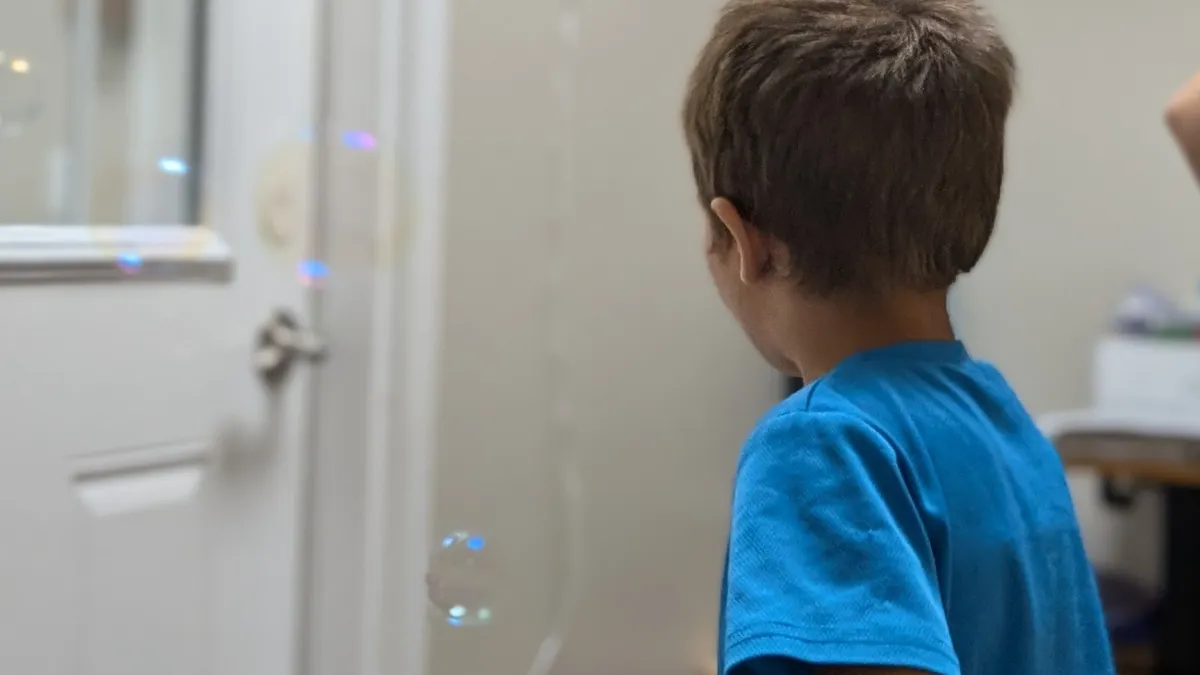
Here is an example. A toddler reaches for a bottle of bubbles. The adult holds it up, says “bubbles?” and waits. When the child says “buh” or even makes a sound toward the bottle, the adult says “Bubbles!” and blows some. The reward is the thing the child wanted, so the child learns that using words works.
The structure is still ABA: a clear opportunity, a response, and a consequence. The difference is who chooses the activity, how rewards are chosen, and how much the adult follows the child’s lead.
How PRT compares with more structured ABA
PRT belongs to a group called naturalistic developmental behavioral interventions. These are used in natural settings, share control between child and adult, use natural consequences, and use a range of behavioral strategies (Schreibman et al., 2015). In a randomized trial, children showed less disruptive behavior during language teaching with PRT than with adult-directed ABA (Mohammadzaheri et al., 2015). Both draw on ABA, and a BCBA may use different strategies for different goals. Our guides to natural environment teaching and ABA techniques for children show how these methods are used.
What the research says
- A randomized trial with young children. The trial included 48 children ages 2 to 5 with significant language delay. Children received a PRT package of parent training plus clinician-delivered sessions at home for 24 weeks, or were in a delayed-treatment group. The PRT group improved more in functional utterances, and 91% of parents delivered PRT with fidelity (Gengoux et al., 2019).
- A review of the evidence. A review of six systematic reviews and 10 randomized trials found significant effects in most trials on a range of language and communication skills, and less consistent effects in other areas. The authors concluded PRT shows promise for language and communication (Uljarević et al., 2021).
- A national evidence review. The National Clearinghouse on Autism Evidence and Practice lists PRT as one of the manualized interventions that meet its criteria for evidence-based practice, grouped with naturalistic intervention (NCAEP report summary, NCAEP FAQ).
What we do not know yet
Researchers are open about limits. A review of PRT research quality found that only two of 17 studies used comparison designs, and treatment fidelity varied (Cadogan and McCrimmon, 2015). A broader meta-analysis of naturalistic interventions found promise for some, but not all, features of autism, with the largest effects for skills that were directly taught and in settings similar to the teaching setting (Crank et al., 2021). In plain words, PRT may help a child communicate more, and families should watch whether new skills show up at home and in other places too.
When to talk with your child’s doctor
PRT is a treatment approach, not a diagnosis. If you are wondering about therapy, start with your child’s doctor:
- Your child has few words or is not trying to communicate by 18 months. The CDC lists trying to say three or more words besides “mama” or “dada,” and pointing to show you something, as milestones by 18 months (CDC).
- Your child has lost words or skills they once had.
- You are worried, even if you cannot say exactly why.
The American Academy of Pediatrics recommends autism screening at 18 and 24 months (Hyman et al., 2020). Your doctor can also point you to speech therapy and a developmental evaluation. For children under 3, Missouri’s First Steps program can be another place to start.
How Reggio ABA relates to PRT
Reggio ABA is AB Spectrum’s own child-led model of care, and it is not the same as PRT. The two share some ideas. Both rest on ABA, and both follow a child’s interests and choices. In our clinics, therapists notice what draws a child in and use it to teach goals, and an RBT works one-to-one with your child using Natural Environment Teaching, with BCBAs supervising. You can read more about our Reggio ABA approach, our child-led Reggio ABA guide, and how a clinic session works. If you are interested in PRT specifically, ask about it on your Welcome Call.
Questions to ask any provider
- How do you choose activities and rewards for my child?
- How do you reward attempts, not only correct answers?
- How will I see progress, and how is data collected?
- How will I learn to use strategies at home?
- Who is the BCBA overseeing my child’s plan?
Frequently asked questions
What is pivotal response treatment (PRT)?
PRT, also called pivotal response training, is a behavioral approach based on applied behavior analysis that teaches in natural settings. It focuses on a few “pivotal” skills, such as motivation, responding to many cues, self-management, and starting social interactions, in the hope that progress spreads to other areas.
Is PRT the same as ABA?
PRT is built on ABA principles, such as clear opportunities, behavior, and consequences, but it follows the child’s choice of activity and rewards real attempts, not only correct answers. Adult-led teaching and naturalistic approaches like PRT both draw on ABA.
What ages is PRT used with?
Research includes young children. One randomized trial enrolled children ages 2 to 5 who had significant language delay. Which children benefit most is not yet clear, since studies have not found a consistent pattern in child characteristics linked to better results.
Does research show PRT works?
Reviews find that PRT shows promise for language and communication. A review of 10 randomized trials found significant effects on a range of language skills in most of them, and less consistent effects in other areas. A national review of autism research counts PRT as an evidence-based practice, and researchers also call for more high-quality studies.
Can parents learn PRT?
Many PRT programs include parent coaching. In a 24-week randomized trial that combined parent training with clinician-delivered sessions, 91% of parents were able to carry out PRT with fidelity. A BCBA or other trained professional should guide any plan so it fits your child and your family’s routines.
Can I try PRT ideas at home?
You can try child-led ideas, such as following your child’s interest, holding a favorite item until your child makes an attempt, and giving it right away. These are simple starting points, not a full program. Ask your child’s BCBA or speech-language pathologist to tailor them to your child.
Related guides
- Natural environment teaching for autism
- ABA therapy examples and techniques
- Motivating operations in ABA
- Child-led Reggio ABA guide
- How many hours of ABA therapy does a toddler need?
Sources
- Lei J, Ventola P. Pivotal response treatment for autism spectrum disorder: current perspectives. Neuropsychiatr Dis Treat. 2017;13:1613–1626.
- Koegel RL, Koegel LK, McNerney EK. Pivotal areas in intervention for autism. J Clin Child Psychol. 2001;30(1):19–32.
- Gengoux GW, Abrams DA, Schuck R, et al. A pivotal response treatment package for children with autism spectrum disorder: an RCT. Pediatrics. 2019;144(3):e20190178.
- Uljarević M, Billingham W, Cooper MN, et al. Examining effectiveness and predictors of treatment response of pivotal response treatment in autism: an umbrella review and a meta-analysis. Front Psychiatry. 2021;12:766150.
- Cadogan S, McCrimmon AW. Pivotal response treatment for children with autism spectrum disorder: a systematic review of research quality. Dev Neurorehabil. 2015;18(2):137–144.
- Mohammadzaheri F, Koegel LK, Rezaei M, Bakhshi E. A randomized clinical trial comparison between pivotal response treatment (PRT) and adult-driven applied behavior analysis (ABA) intervention on disruptive behaviors in public school children with autism. J Autism Dev Disord. 2015;45(9):2899–2907.
- Schreibman L, Dawson G, Stahmer AC, et al. Naturalistic developmental behavioral interventions: empirically validated treatments for autism spectrum disorder. J Autism Dev Disord. 2015;45(8):2411–2428.
- Crank JE, Sandbank M, Dunham K, et al. Understanding the effects of naturalistic developmental behavioral interventions: a Project AIM meta-analysis. Autism Res. 2021;14(4):817–834.
- National Clearinghouse on Autism Evidence and Practice. Evidence-based practices for children, youth, and young adults with autism: executive summary (2020).
- National Clearinghouse on Autism Evidence and Practice. Frequently asked questions about the NCAEP report.
- Hyman SL, Levy SE, Myers SM. Identification, evaluation, and management of children with autism spectrum disorder. Pediatrics. 2020;145(1):e20193447.
- Centers for Disease Control and Prevention. Milestones by 18 Months (Learn the Signs. Act Early.).
Choosing a therapy for your child can feel like a big decision. You do not have to figure out the jargon alone, and your questions are always welcome. We’re here for you.
Getting help in the St. Louis area
AB Spectrum provides clinic-based Reggio ABA therapy, speech therapy, and autism evaluations for children ages 1–6. Care is designed and supervised by a BCBA. Families can visit our Chesterfield, Florissant, St. Peters, or Wright City clinic, and you can see every clinic on our locations page. You can read how getting started works, or schedule a Welcome Call to talk through your child’s needs with our team.